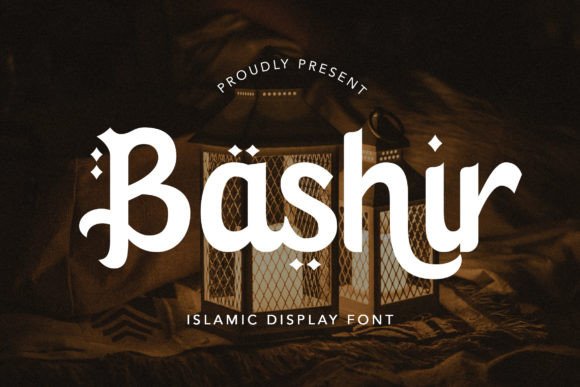
Bashir: An Elegant Islamic Display Font for Handmade Creators
As a maker who designs printable wall art, boutique gift tags, wedding stationery, and custom packaging for small-batch candles and soaps, I’m always searching for fonts that do more than just look beautiful—they need to work. Bashir is one of those rare display fonts that balances intricate artistry with real-world usability. Its flowing lines and delicate calligraphic rhythm evoke centuries of Islamic design tradition, yet it feels fresh, intentional, and deeply respectful—not ornamental for ornament’s sake, but expressive in purpose.
Bashir shines brightest where attention matters: on the front of a hand-stamped invitation, the belly band of a bridal favor box, or the header of a digital planner page meant to inspire daily reflection. It’s not built for paragraphs—it’s a display font, designed for short, meaningful phrases: “Bismillah,” “Alhamdulillah,” “Barakah,” names, titles, or sacred phrases. That focus makes it incredibly effective for physical product labeling—think cotton tea towel tags, ceramic mug decals, or foil-stamped greeting cards where every letter carries weight and warmth.
I’ve used Bashir across several product categories with consistent results. On Cricut-cut vinyl stickers for Ramadan planners? Crisp and legible at ¾ inch tall—just be sure to avoid ultra-thin swashes if cutting at under ½ inch. For laser-printed boutique soap labels? It holds up beautifully on matte kraft paper, especially when paired with a light cream or deep indigo background. And for printable Eid greeting cards? The subtle ligatures and alternate glyphs (which Bashir includes in its OpenType features) let me swap in graceful flourishes without switching fonts—keeping my workflow tight and brand-consistent.
Readability is practical, not theoretical. Bashir remains clear even at 14–16pt on printed invitations, provided you use its standard weight (not ultra-light variants) and allow generous letter spacing. For SVG-based cut files, I always convert text to outlines before exporting—this prevents rendering hiccups in Silhouette Studio or Cricut Design Space, especially with connected strokes. And because Bashir supports Arabic and extended Latin characters, it works seamlessly for bilingual baby shower invites or multicultural wedding signage—no awkward font-switching mid-design.
Where Bashir truly elevates handmade goods is in perceived value. A simple cotton tote bag with “Jazakum Allahu Khairan” in Bashir feels thoughtfully curated—not mass-produced. A set of printable dua cards gains quiet reverence from its refined curves. Customers notice that difference. They feel it in the care behind the craft—and that translates directly into repeat orders, social shares, and word-of-mouth trust.
Font pairing is where Bashir becomes even more versatile. I often layer it over clean sans serifs like Montserrat or Poppins for contrast—Bashir handles the soul, the supporting font handles the structure. For wedding stationery, I’ll pair Bashir’s title line with a gentle serif like Playfair Display for body text; for modern Islamic wall art prints, a minimalist geometric sans like Manrope keeps the focus on Bashir’s elegance without competing. Avoid pairing it with other highly decorative scripts—too much movement distracts. Let Bashir lead, then anchor it with calm, functional type.
Practically speaking, Bashir comes in multiple weights (Light, Regular, Bold), includes stylistic alternates and contextual ligatures, and is delivered in both OTF and WOFF formats—so it’s ready for print, web mockups, and digital downloads alike. If you’re creating Canva templates or editable PDF planners, those OpenType features mean your buyers get polished, professional-looking results without needing advanced design software.
Licensing is non-negotiable for sellers—and Bashir’s commercial license covers exactly what we need: physical products (stickers, mugs, apparel), digital downloads (printables, SVG bundles, Procreate brushes with embedded text), client work (like designing a mosque newsletter or Islamic school branding), and even resale in template marketplaces. Just double-check your license permits unlimited end-product sales—most premium display fonts do, but it’s always worth verifying before listing your first Bashir-powered product on Etsy or Gumroad.
Seasonal projects are another sweet spot. I’ve used Bashir for Eid al-Fitr banners, Hajj journal covers, Ramadan countdown calendars, and even minimalist “MashaAllah” nursery wall decals. Its timeless quality means it never feels dated—unlike trend-driven scripts that fade after a season. It also scales beautifully: large-format farmhouse-style signs (cut from birch plywood) retain grace at 12 inches tall, while tiny ⅜-inch sticker versions still read clearly on spice jar labels or hijab pin packaging.
If you're building a cohesive brand identity—especially one rooted in faith, mindfulness, or cultural heritage—Bashir isn’t just a font choice. It’s a quiet statement of intention. It tells your customer: *This was made with care. This honors tradition. This belongs.* And in a crowded handmade marketplace, that resonance is priceless.
Whether you're sketching layout ideas on paper or fine-tuning kerning in Illustrator, Bashir invites slowness, respect, and precision—the same values many of us bring to our craft. It doesn’t shout. It glows. And in the right context—with thoughtful pairing, smart sizing, and intentional placement—it transforms ordinary products into keepsakes.